- DATE:
- AUTHOR:
- The Fountain team
Applicant Consent Updates for SMS and Calls
We're improving how applicants give consent for SMS and calls, so they stay reachable about their own application.
Application forms asked applicants to tick separate boxes before Fountain could text or call them about their own application. Customers told us those checkboxes made applicants harder to reach about the job they had just applied for. Fountain reviewed the approach with external counsel and with Bird, our SMS provider, which took the hiring use case back to the carriers, and agreed on a clearer model.
What's new
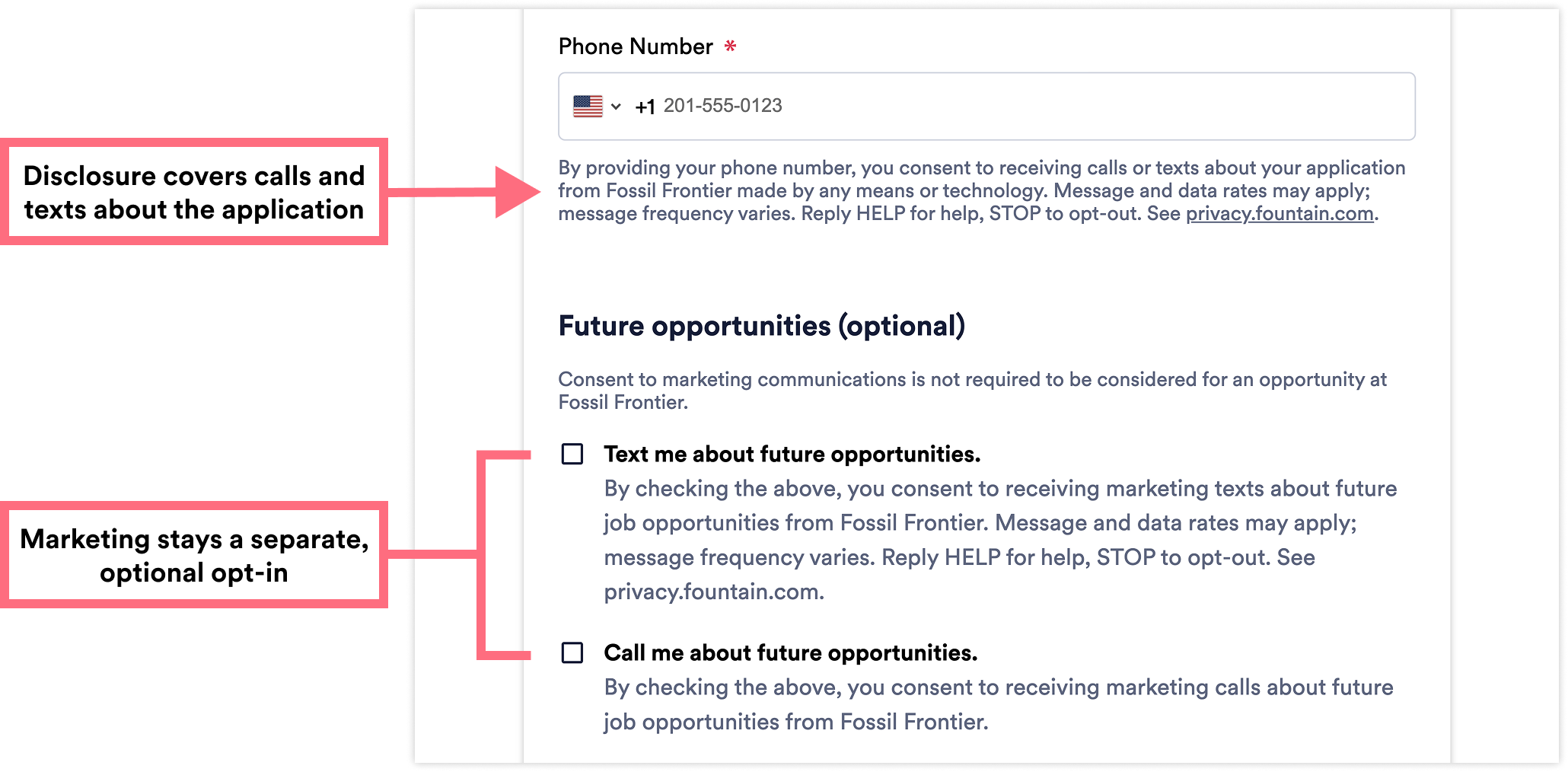
Disclosure-based transactional consent — Applicants see disclosure copy near the phone field explaining how their number may be used for calls or texts about their current application, in place of separate transactional checkboxes. Submitting the form after that disclosure records transactional SMS and call consent. The exact wording may vary by region.
Marketing stays separate and optional — A Future opportunities section carries its own opt-ins, unchecked by default. Submitting an application does not opt an applicant into marketing, and applicants can still reply STOP at any point to stop receiving SMS.
A setting to stop asking for marketing consent — Coming next. Customers who do not use Fountain for marketing or future-opportunity outreach will be able to hide that section entirely. It is shown by default.
Your own Privacy Policy and Terms links — Coming next. You will be able to add your Privacy Policy and Terms of Service links to the application form footer, alongside Fountain's.
Consent capture beyond the application form — Coming next. Indeed Apply, ZipRecruiter Apply, and other direct sourcing channels will ask for and record consent the same way, because an applicant arriving through those paths never sees the application form disclosure.
Link-based opt-out for one-way SMS — Coming next, for markets where replying STOP is not reliable. Two-way SMS continues to use the existing STOP and START behavior.
Why it matters
SMS is how frontline hiring actually moves. An applicant who skipped a checkbox at the top of the form became difficult to reach about the job they had just applied for. The improved approach keeps the compliance distinction intact, with application-related contact handled through clear disclosure and marketing handled as a separate opt-in, while removing friction that was costing customers reachable candidates.
What to expect
If you create applicants through the Fountain API or by CSV import, this is the part that needs your attention. Because those applicants never see the Fountain application form, you are responsible for the consent you pass. Career sites, apply flows, middleware, integrations, and CSV templates will need to set explicit true or false values for four granular consent variables:
Transactional SMS consent
Transactional call consent
Marketing SMS consent
Marketing call consent
These fields are available now, so you can start updating ahead of enforcement. There is a 90-day migration window, after which applicant creation will fail if any of the four values are left blank. If you disclose the use of the phone number wherever you collect it, you can set the transactional values to true; a separate checkbox is not required. If you are unsure whether your integration is affected, contact your Customer Success representative.
Common questions
Does this mean applicants no longer consent to SMS or calls?
No. Applicants see disclosure explaining that they may receive SMS or calls about their application, and consent is still recorded for all four types. What improves is that transactional contact no longer requires separate checkboxes. Marketing consent is different and still requires an explicit opt-in.
What do applicants see on the form?
Disclosure language near the phone field explaining how their number may be used for application-related SMS or calls. They no longer see transactional SMS and call checkboxes. They still see a separate Future opportunities section for marketing, unchecked by default.
How is this different from the previous model?
Consent for different purposes is separated more clearly. Contact about an applicant's current application is transactional and handled through disclosure, while contact about future opportunities is marketing and remains opt-in.
Does this change anything for WhatsApp?
No. WhatsApp messaging is governed separately, with its own limits on marketing versus utility templates rather than the same consent requirements, so this change does not alter how WhatsApp behaves.
How do we make sure we only send marketing to applicants who agreed to it?
Consent attributes are available in workflow rules, so you can route applicants based on what they agreed to. A common pattern is to route applicants who declined marketing away from a re-engagement stage, so future-opportunity outreach only reaches people who opted in.
Do we need to do anything?
If your applicants come primarily through Fountain application forms, the expected action is minimal: review the updated experience and raise any account-specific concerns. If you create applicants through the API or CSV import, plan the integration update described above.
Availability
Now available to an initial group of customers — contact your Customer Success representative to get access.